Why Add an Outdoor Hot Tub Instead of Heating Your Pool (Thailand Guide for Expats)
Own a pool in Thailand? A separate outdoor hot tub costs less to heat, is easier to maintain, and delivers real hydrotherapy. See why.
Who this is for
If you’re renovating or building a home in Thailand—with a compact plunge pool, a family-size pool, or a long lap pool—and you’re debating between adding heated spa seats in the pool or installing a separate outdoor hot tub, this guide explains why a stand-alone hot tub is usually the smarter, more enjoyable, and more economical upgrade.
Quick comparison
| Feature | Heated Pool to 35–40°C | Separate Outdoor Hot Tub |
|---|---|---|
| Water volume to heat | Very high | Low |
| Insulation & cover | Rare | Standard (insulated shell + cover) |
| Time to reach temp | Long | Short |
| Energy use to maintain | High | Low |
| Chemistry upkeep | Higher/frequent | Lower/faster |
| Hydrotherapy | Limited jets | Full-body, adjustable |
| Repairs | Often invasive | Easy access |
| Year-round usability | Weather-dependent | Any evening, any season |
1) Energy use: small volume, big savings
Most pool owners want soak-ready water at 35–40°C for relaxation and recovery. Heating an entire swimming pool to that temperature is expensive because:
- Pools hold a large water volume.
- Pool structures (concrete, fiberglass, vinyl) aren’t insulated.
- Heat escapes from the surface, sides, and the ground—and pools typically don’t have insulating covers.
Even with an efficient heat pump, the system often needs to run for long hours just to maintain temperature.
A separate outdoor hot tub solves this:
- Much less water to heat.
- Built-in insulation around the shell.
- Lockable cover that keeps heat in and debris out.
- Compact heater (often ~3 kW, model-dependent) can maintain your set temperature with short daily cycles, keeping the spa ready 24/7 without running all day.
Bottom line:
You get true hot-water comfort for a fraction of the running cost of heating the whole pool.

2) Water care: easier, cleaner, faster
Warm water changes how you maintain hygiene:
- At higher temperatures, microorganisms multiply faster and sanitiser is consumed more quickly.
- Sunlight breaks down chlorine faster, and tropical rain can dilute or upset your pool chemistry.
If you heat a pool to spa temperatures, you’ll typically need more frequent testing, more chemicals, and more time.
With a hot tub:
- Smaller water volume means quicker adjustments and lower chemical use overall.
- The insulated cover shields from sun, dust, and rain.
- Whether you prefer traditional chlorine, bromine, it’s simpler to keep spa water crystal-clear and ready whenever you want to soak.
Note on salt systems: A “salt pool” still creates chlorine via electrolysis. Warm water demands a higher output; doing this for a whole pool accelerates wear on salt cells.
Salt-water pools don’t sanitize with salt alone—the
salt cell (a titanium electrode) converts salt into chlorine and it wears out and must be replaced. When you heat an entire pool to
35–40°C, chlorine demand rises, scale forms faster, and the cell must run longer and be cleaned more often, so you’ll
replace it sooner than in a normal
27–30°C pool. Oversizing the cell only partly helps and
costs more upfront and at replacement. The smarter setup in Thailand is to keep the pool at normal temperature and add a
separate insulated hot tub for 35–40°C soaking—so you get hydrotherapy without burning through your pool’s salt cell.
3) Real hydrotherapy: targeted jets you can feel
- Pool spa seats = limited: Typically 1–2 jets/seat with shared plumbing → restricted pressure/placement.
- Hot tub = hydrotherapy-first: Multi-zone jets mapped to neck, shoulders, mid-back, lumbar, hips, calves, feet (+ optional wrists/palms).
- Fine-tune every seat: Air controls, diverter valves, directional nozzles tailor intensity and flow.
- Mix of jet styles: Rotational (kneading) for tension, direct (deep/trigger-point) for focus, footwell jets for a full-body finish.
- Therapeutic temperature: 35–40°C delivers consistent, repeatable sessions for post-workout recovery, travel stiffness, long workdays.
- Stable performance: Small water volume + insulated shell hold temperature easily → strong, steady massage (no warm-spot hunting or weak flow).
- Result: A true,
head-to-toe massage experience
pool jets can’t match.

4) Comfort that keeps you in the water longer
- Biomechanics-driven design: Interiors sculpted for human ergonomics.
- Stay anchored: Anti-float loungers + deep therapy seats keep you in position under powerful jets.
- Fits everyone: Multiple seat depths—chest, shoulder, neck—to suit different heights and preferences across the family.
- Targeted support: Ergonomic backrests, lumbar support, contoured calf/foot wells reduce pressure points; headrests cradle the neck during high-flow massage.
- Smart pacing: Cool-down perch near the waterline for quick breathers between jet cycles.
- Every-evening usability: Non-slip steps, easy-reach controls, quiet circulation make sessions comfortable and frequent.
- Why not the pool: Pools are built for swimming first, not long restorative soaking—rarely this level of seating ergonomics.
- Net effect: You’ll stay longer, relax deeper, and get more value from every session.
5) Serviceability: quick fixes, lower costs
- Pool spa downside: Buried plumbing → diagnosing weak jets/leaks can mean demolition, days off-use, high repair bills.
- Hot tub advantage: Designed for fast access and minimal downtime.
- Total access: Removable side panels give 360° reach to pumps, heaters, control packs, plumbing.
- Quick swaps: Modular components with union fittings let techs replace parts without cutting concrete.
- Simplified layout: Single equipment bay groups electronics and valves → easier routine maintenance.
- Durable shell: Acrylic reinforced with fiberglass resists surface leaks and is straightforward to service.
- Faster troubleshooting: Many systems include self-diagnostic controls → issues often solved same-visit.
- Translation: Fewer surprises, lower lifetime service cost, and no deck tear-up to get your jets working again.

6) When a Heated Pool Makes Sense (Rare Cases)
- You swim laps daily and prefer mild warmth (about 28–32°C, not 35–40°C).
- You often host large groups who all want warm water at the same time.
- You accept
higher ongoing energy/chemical costs and
faster salt-cell wear/replacements.
Bottom line: For most expat homes in Thailand, a separate outdoor hot tub beside a normal-temp pool delivers better comfort, lower running cost, and easier care.
7) Place Your Hot Tub Beside the Pool (Hot–Cool “Two-Water” Routine in Thailand)
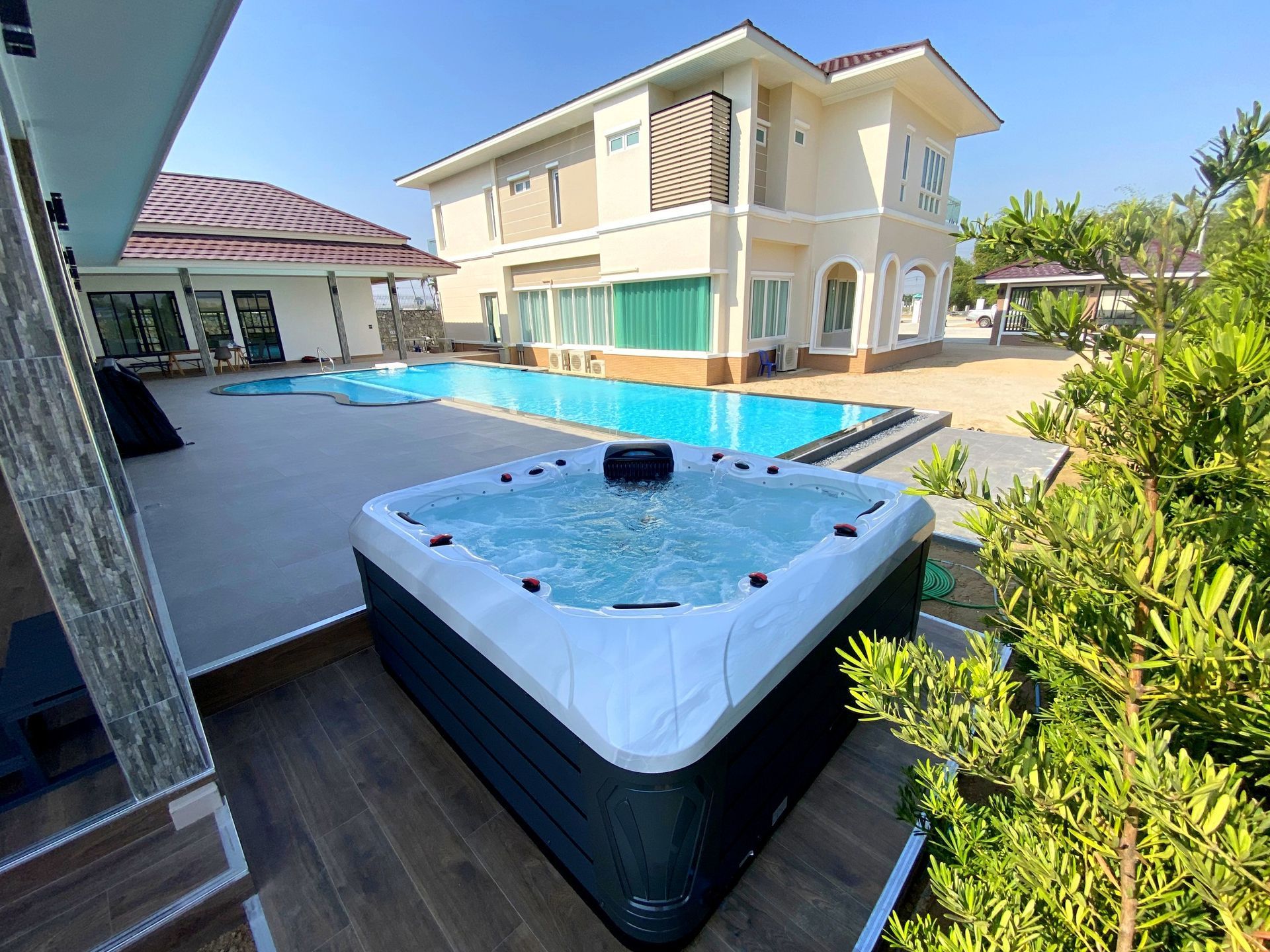
Installing your hot tub right next to the swimming pool unlocks a routine most owners end up loving: soak in 35–40°C water, then switch to 27–30°C pool water. The temperature contrast plus the different depths gives you a completely different level of relaxation compared to soaking in warm water alone.
“When I soak in warm water and then switch to my regular-temperature pool, I feel more relaxed—like another level of calm.”
— [Wuttchai], Owner/Seller, [Q&G], Thailand
Why the hot-to-cool switch feels so good (in plain English)
- Deep release, then refresh: Warm water and jet massage help muscles loosen and your mind calm down. The cool pool brings a clean, refreshing reset so you finish feeling light, clear-headed, and energized—not sleepy.
- Jets + buoyancy: After a full-body jets massage in the hot tub, jumping into the deeper pool lets the water lift your body to float. That weightless feeling takes pressure off joints and completes the relaxation cycle.
- Circulation rhythm: Alternating warm and cooler water encourages a gentle circulation “wake-up”. Many people say it helps them bounce back after workouts and long days.
- Perfect for Thailand’s climate: Even on warm evenings, the pool’s regular temperature (typically 27–30°C) makes the cool phase comfortable—not shocking—so the routine is easy to enjoy year-round.
Practical benefits of locating the hot tub beside the pool
- Seamless switching: A few steps is all it takes. No walking across the yard or through the house—so you’ll actually use the routine more often.
- Cleaner water, less mess: Keep both waters pristine by placing an outdoor shower and towel hooks between them. Rinse, soak, switch—simple.
- Space efficiency: One shared deck for seating, privacy screens, and lighting keeps the whole zone tidy and good-looking.
- Energy-smart habits: Because the spa is covered and insulated, it stays ready at 35–40°C with short maintenance cycles. You only heat the small spa volume—not the whole pool.
- Social flow: It’s a fantastic family & friends setup—some relax in the spa while others splash in the pool, and everyone can rotate between the two. Kids love the variety (with supervision), and adults get true hydrotherapy.
- All-weather enjoyment: On rainy or cooler nights, the hot tub keeps the party going. On hot afternoons, the pool cool-down balances the heat soak so you can relax longer.

Design & installation tips for a great side-by-side setup
- Distance: Keep the hot tub 1–3 meters from the pool edge—close enough to switch easily, far enough for safe walking and a cover lifter.
- Footing: Use non-slip decking with gentle drainage so feet stay clean and safe when moving between waters.
- Cover & lifter: A lockable insulated cover plus a cover lifter makes one-person operation effortless (and keeps the heat in).
- Power & protection: Install a dedicated, RCD-protected circuit sized for your model. Ensure good equipment access for service.
- Privacy & vibe: Soft path lighting, screening plants, and a bench for towels/robes turn the area into a resort corner.
- Rinse point: A quick outdoor shower right between pool and spa keeps both waters clearer with fewer chemicals.
Who benefits most from the “two-water” layout?
- Active homeowners who want muscle relief from jets, plus a refreshing finish.
- Families & hosts who want one shared area where everyone can enjoy—spa soakers and pool swimmers together.
- Remote workers who need a fast evening wind-down that leaves them relaxed yet refreshed.
- Anyone who found “hot soak only” a bit heavy—and wants that light, floating finish in the pool.
Bottom line: Placing your hot tub beside the pool creates a unique hot-to-cool ritual you’ll actually use. You get full hydrotherapy at 35–40°C, an easy switch to 27–30°C for that floating, refreshed finish, and a beautiful social zone the whole household—and your guests—can enjoy.
FAQs
Is a hot tub really better than heating my whole pool?
For hydrotherapy at 35–40°C, a separate hot tub wins on comfort, energy use, and maintenance. You heat a small, insulated volume with a lockable cover, not the entire pool.
How much cheaper is it to run?
Running costs are significantly lower because the spa’s insulation + cover hold heat and the water volume is small, so heaters run shorter cycles versus maintaining an entire pool at spa temps.
How long does a hot tub take to heat up?
From ambient to 38–40°C typically takes hours, not days (exact time depends on size, heater power, and weather). Many owners simply keep it at temperature for “always-ready” soaking.
Will a hot tub feel too warm in Thailand?
Most owners soak after sunset ,night time morning time. You can also set the spa to 32–34°C for a “warm plunge” that’s gentle in hot weather, then raise it when you want deeper therapy.
Do hot tubs give real hydrotherapy or just bubbles?
Dedicated hot tubs use multi-zone jets (neck, shoulders, back, lumbar, hips, calves, feet) with air controls, diverters, and directional nozzles—far more targeted than typical pool “spa seats.”
Ready to enjoy your pool and a true hydrotherapy soak? Book a free site consultation. We’ll recommend the right-size hot tub, power setup, and placement—so you can step into 38–40°C comfort any evening, year-round.
Energy-efficient hot tubs in Thailand : QandGTub.com